Protect your child against measles
The NHS is urging parents and guardians across Lincolnshire to ensure their children are fully vaccinated against measles as cases continue to rise particularly amongst six to 12-year-olds.
The reminder follows current measles outbreaks, particularly in London, which have demonstrated how quickly measles can spread among people who are unvaccinated.
“In the south of the country there are a number of schools experiencing fast spreading outbreaks of measles, with some children being hospitalised as a result,” said Steph Hart, Assistant Locality Lead – Vaccination Programme, NHS Lincolnshire Integrated Care Board (ICB).
In Lincolnshire, last year 90.3% of children had one dose of the MMR (Measles, Mumps and Rubella, (now MMRV – Measles, Mumps, Rubella, Varicella in the routine vaccination schedule) vaccine by the age of 2, and 92.5% by the age of 5. However, only 84% had two doses of MMR by the age of 5, when the target is 95%.
“Currently, measles outbreaks are focused in the main on six to 12-year-olds and (as of 2025) 93.7% of these children have received one MMR vaccine against measles, but only 88% have received both doses, with uptake rates in some parts of the county considerably lower than this,” added Steph.
“Measles is a nasty illness for any child but for some it can lead to long-term complications and even death. Getting your child vaccinated is the best way to protect them and to help prevent the spread of measles, as well as the risk of them being significantly ill.”
Measles is one of the most infectious diseases and spreads quickly in classrooms, playgrounds and households where children have not been vaccinated.
“Children who have missed doses should have these as soon as possible. If they have not had two doses of MMR/MMRV they will not be fully protected. It is also worth remembering that, in addition to protecting themselves and limiting the spread of measles, getting vaccinated will also indirectly help protect children who are currently too young to get vaccinated and those with weakened immune systems.
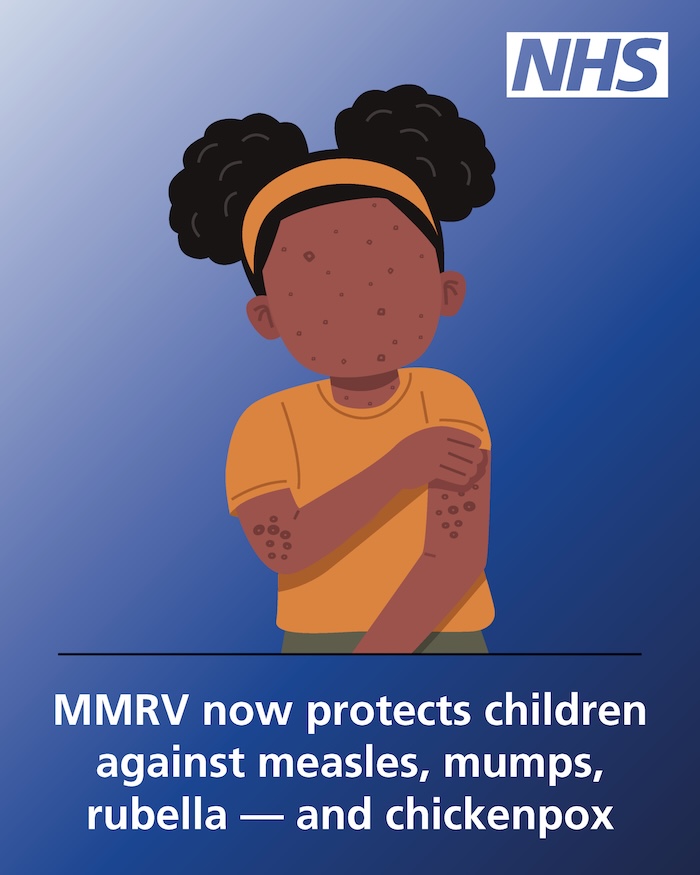
“From 1 January 2026, all children will be offered the MMRV vaccine as part of the childhood routine 2 dose vaccination schedule. This means children turning 1 year from 1 January 2026 will be offered two doses – one at 12 months and a second at 18 months. The MMRV vaccine protects against measles, mumps, rubella, and now varicella – otherwise known as chickenpox – too, all of which are very easy to catch and spread without the protection of the vaccine” explains Steph.
The MMRV vaccine has been used safely around the world for several years now and any side effects are usually mild and only last two to three days.
“There will also be a single dose MMRV catch up programme for children up to the age of 6 starting later in 2026, which is about going further and more rapidly to reduce transmission of chickenpox in the population.
Older children and some adults who have not been vaccinated remain eligible to catch up but will be offered the MMR vaccine.
A child’s GP surgery will usually invite them for the first dose of MMRV around their first birthday with a second dose after 18 months. Older children who missed doses will be able to get them at their GP surgery. Children may possibly receive these at their secondary school through the School Age Immunisation Service (SAIS).