
Gritty facts about keeping our roads clear and safe
A multi-faith ceremony takes place to bless Lincolnshire County Council’s gritters and work crews as well as road users.
The annual blessing marks the symbolic start to the gritting season and the colder weather with the salting team given specific messages of faith and goodwill from Christian, Sikh and Hindu communities in the county.
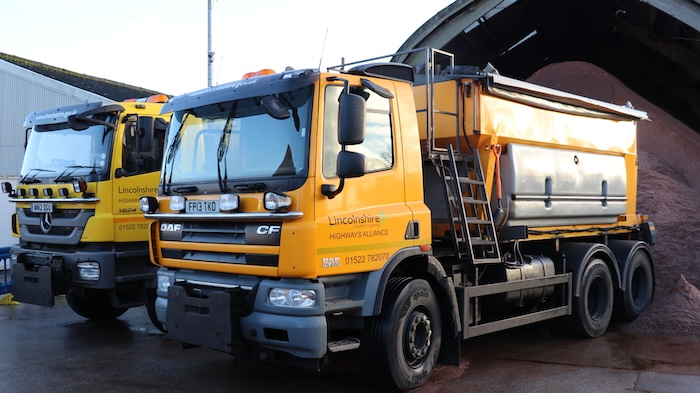
Religious representatives visited the council’s Ancaster depot to share prayers and positivity about keeping 5,500 miles of Lincolnshire roads open. The group’s good wishes were spread across the gritting fleet of 47 machines, materials, staff and road users ahead of the wintry temperature drop that will soon descend across the county.
Stuart Cradduck, Rector of St Wulfrum’s Grantham, Nina Chapman Lay Hindu Chaplain at University of Lincoln, Jasmit Kaur Phull Sikh Chaplain at University of Lincoln, Reverend Steve Holt Christian Chair of the Centre for Reconciliation and Alicia Armsworth Multi-faith Chaplaincy Administrator at University of Lincoln took part in the ceremony.
Gritters go out when road surface temperatures drop to around 0.5°C, covering nearly 2,000 miles of highway, including all A and B roads, at least one road into all the county’s main towns and villages, and routes around bus and train stations, hospitals and schools.
Grit bins for residents’ use on public paths and roads are also provided with 30,000 tonnes salt stored across eight county to supply these are and the gritters.
Darrell Redford, Lincolnshire County Council’s Network Resilience Manager, is in charge of the fleet.
“Looking after the roads in severe temperatures is a really complex job but we know what we’re doing and we’re ready to get out to increase grip. Our team is out in all hours to make the roads safer across the colder months.
"Our drivers are very talented at what they do. To back them up we use a host of data and live information to work out when and where to spread the right amount of salt – the men and women of the gritting team, plus that vital information is a combination that’s effective and efficient in keeping roads open in the worst conditions.
"It’s very clear that what we do with our gritting programme is important for everyone on the roads, but a large part of road safety also relies on everyone on the roads to drive in the right way for the conditions. It’s a simple message to all: be safe, be aware and be kind to other road users.”
Modern techniques gets the right amount of salt to the right places when temperatures plummet.
Darrell adds: “We have a lot of data coming to us all the time. We have our own 12 weather stations in Lincolnshire that we use and we also get information from another eight outside of the county that aren’t ours, but we use them as part of data share with other areas.
“This live reporting is very accurate and really helps us predict what weather fronts are moving across the area. There are two stations in each domain, which are: the Wolds, the Coast, Grantham and Grantham Ridge, Lincoln Ridge and the Fens.
“We have something called route-based forecasting where each route has its own forecast, based on the specific domains. This means that we can send out the appropriate gritters for the appropriate areas as needed. That alone save us a lot of money and resource.
The gritty facts
- The county has a budget of £1.2m a year for salt. The molasses-treated salt that is bought in will last for five years – this lifespan had never been tested though as the salt stored is always used well before the five years is up
- There are 47 Gritters that serve the county – these range from mainly 26-tonne gritters with 10-tonne hoppers,18-tonne lorries with 6-tonne hoppers on the back and smaller 10-tonne versions with a 3-tonne hopper on the back
- Lincolnshire County Council holds 29,200 tonnes of salt in the county’s depots
- On average, Lincolnshire County Council uses 20,000 tonnes of salt a year
- The most salt ever used in one winter was across the 2010/11 ‘Beast from the East’ brutally cold season. That year a massive 38,000 tonnes of salt was put down on the roads
- There are 12 weather stations around the county feeding data back about the weather and road temperatures. Lincolnshire County Council has access to eight others sited with other counties which help to more accurately predict weather systems as they come across the country
Top picture shows from left: council officer Tim Hunter, Reverend Steve Holt, Cllr Michael Cheyne, Father Stuart Cradduck, Chaplain Jasmit Kaur Phull, Alicia Armsworth, Cllr Sean Matthews, Chaplain Nina Chapman and gritter team manager Darrell Redford at the blessing ceremony. Pictures: Lincolnshire County Council.